Big Moth 2
System Design
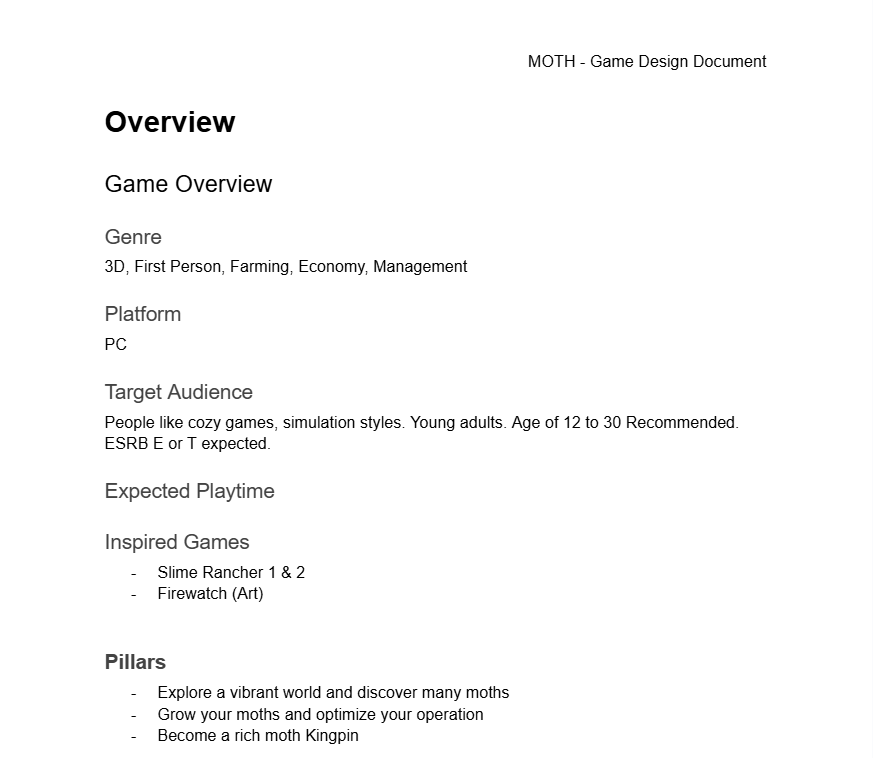
Big Moth 2 is a 3D first-person farming, economy, and management RPG.
Where players catch, breed, and sell moths in a dynamic market.
Inspired by Slime Rancher and the immersive atmosphere of Firewatch, the game combines relaxing exploration with deep economic strategy.
Information
Role
Lead Designer, Systems & Level Designer
Date
09/2024 ~ 04/2025
Genre
3D First-Person Moth Farming Adventure RPG
Engine & Tools
Engine: Unreal Engine 5.4.4
Tools: Microsoft Excel, Microsoft Whiteboard,
Machination, Desmos, Perforce
Project Type & Team
Academic Project, Team Practically Malware (22 People)
Location
DigiPen Institute of Technology, Redmond, WA,
United States

Process Overview
- Big Moth 2
System Design
As the lead designer on MOTH, I guided the game’s system direction and structure.
I designed the request-based reward system, created passive effects tied to moth slots and framing, and adjusted progression by curating moth spawns across areas of the game. These systems were iterated to support player planning, pacing, and mechanical clarity.
I also authored all gameplay requests and balanced their impact on the economy and player flow. While I contributed to the GDD, my main role was refining the document and revising ideas if necessary. Ensuring overall cohesive documentation quality.
Below is a step-by-step breakdown of making Big Moth 2.
Work Process
Concept & Direction Leading
- Proposed the original system concept of Big Moth 2; Moth-catching, breeding, and management sim with an economy-focused core.
- Defined the game’s tone, platform direction, and player fantasy.
- Structured the experience around player agency through collection, progression, and choice-based rewards.
- Provided design leadership and high-level system direction throughout development.
System & Progression Design
- Built the core gameplay loop around request-based rewards rather than direct selling.
- Designed the framing-based passive system and slot-based bonuses.
- Directed progression pacing by defining moth spawn types and locations across Area 1 to 3.
- Iterated moth unlock flow and adjusted pacing to support exploration and economy depth.
Economy & Passive Balancing
- Designed all moth passives, including both slot effects and framing bonuses.
- Authored all request types with custom conditions, tiers, and payout logic.
- Tuned reward scaling and passive synergy through multiple iteration cycles.
- Ensured player income curve and power scaling felt natural and responsive.
Documentation
& System Cohesion
- Participated in GDD writing by reviewing and refining existing content. Maintaining clarity, cohesion, and scalability.
- Identified incomplete areas and injected new design ideas as needed.
- Acted as a bridge between design vision and implementation through structured feedback.

Concept & Direction Leading
I designed the initial system structure and gameplay direction. I proposed the core loop of catching, hatching, and fulfilling requests through a passive economy system, and shaped how the player interacts with moths in both functional and emotional ways.
From the start, I emphasized clarity, simplicity, and progression through planning rather than action. This shaped the tone and pacing of the entire experience, grounding the design in structured systems that allow for expressive play.
I also led early design discussions regarding system cohesion, player motivation, and pacing. These ideas became the foundation for how the rest of the game evolved.
System & Progression Design
I led the design process of the game’s core gameplay systems, focusing on player-driven progression and economic interaction. Rather than traditional item-selling loops, I designed a request-based system that encouraged players to catch and deliver specific moths to fulfill quests with meaningful rewards.
The passive system was built around two components: slot-based effects that activated while moths were equipped, and framing-based bonuses that activated when moths were retired and displayed. These systems were tightly interwoven to reward both short-term usage and long-term planning.
To ensure a smooth gameplay curve, I carefully mapped moth spawn types and placements across Areas 1 to 3, curating when and where players encounter specific moths. Through iteration and feedback, I refined the unlock pacing, ensuring the discovery loop remained satisfying and that economic growth felt intuitive and earned.


Economy &
Passive Balancing
To support the game’s economy-driven gameplay, I designed the full library of moth passives, carefully balancing both slot-based effects and framing bonuses to ensure diversity and synergy effects. Each passive was created with a specific use case in mind, ranging from utility boosts to progression accelerators, which encourage players to experiment with combinations across different systems.
I authored every request type in the game, defining custom conditions, tiers, and payout logic that shaped how players earned gold and which moths gained value over time. These requests replaced traditional item selling, making the economy a goal-oriented experience instead of a raw transactional loop.
Through multiple balancing passes, I adjusted reward scaling, passive power levels, and effect potentials, making sure that progression felt organic and that no single strategy dominated. I focused especially on player income curves, tuning the economy so that rewards ramped meaningfully with skill and investment, while still offering viable paths for different playstyles.
Documentation & System Cohesion
As a co-author of the GDD, I played a key role in maintaining the structure and clarity of the design documentation. I reviewed and revised major sections to ensure alignment with evolving gameplay systems, identifying gaps in logic or flow and proposing actionable solutions.
Throughout development, I contributed new ideas where needed and helped define the connective tissue between isolated features, making sure that every mechanic, from passives to progression, supported the game’s core fantasy and player experience.
Beyond that, as the design lead, I also acted as a bridge between vision and execution, providing structured feedback that helped the team stay aligned on gameplay priorities, system behavior, and overall pacing. My involvement in documentation was focused on clarity, cohesion, and reinforcing a unified design direction.